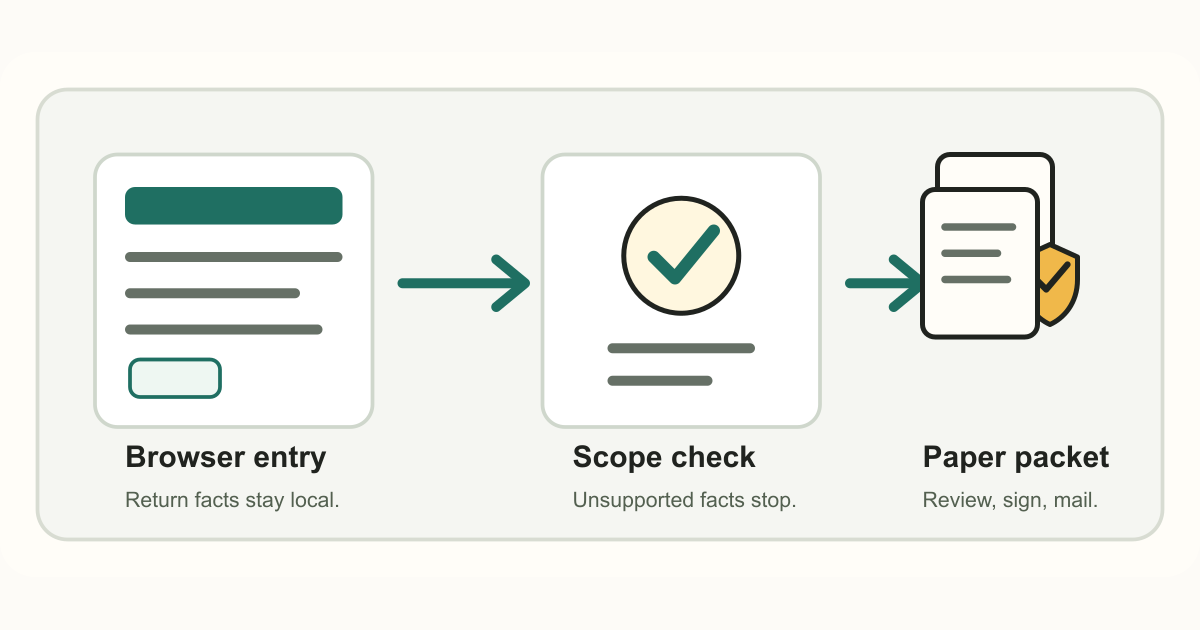
Quick answer
For Form 56 records, keep the signed notice, authority documents from the fiduciary's own records, the IRS source used, mailing or delivery proof, and any later IRS correspondence. Tax Paperwork does not prove authority, mail Form 56, open account access, or confirm IRS processing.
Sources and limits
Use the linked IRS Form 56, instructions, and Form 2848 pages as official source starting points. This guide is for orientation and does not provide tax, legal, fiduciary, probate, estate, trust, refund, representative-authorization, mailing-address, account-access, or filing-channel advice.
Proof to keep before mailing
- The signed Form 56 notice and the tax matters or form numbers covered by the notice.
- Letters testamentary, court appointment, trust instrument, agency, or other authority records from the fiduciary's own file when relevant.
- The dated IRS Form 56 instruction source used for current filing mechanics.
Proof to keep after mailing
- Mailing receipt, private-delivery record, or other customer-owned delivery proof.
- Any IRS response, rejection, notice, correction request, or account correspondence.
- Internal notes showing who reviewed the authority and signature before the notice was sent.
Authority and representative boundaries
Form 56 is a fiduciary notice, not proof that a person has authority in every estate, trust, probate, refund, or account-access situation.
Tax Paperwork does not decide who may act as fiduciary and does not substitute for Form 2848 when representative authorization is needed.
When to stop
- Authority is contested, missing, expired, revoked, or tied to active probate, trust, estate, refund, or court questions.
- The user wants IRS account access, professional representation, refund handling, identity-theft handling, or Tax Paperwork mailing.
Related Guides And Draft Previews
How this page was prepared
This page starts from the official sources linked below, keeps filing-channel decisions with IRS.gov or qualified professionals, and shows the same limits that appear in the public draft previews.
Tax Paperwork pages are maintained under the editorial policy and checked against the public-preview evidence described on the preview confidence page. Last page review: June 18, 2026.
Current Tax Paperwork boundary
Tax Paperwork is not tax, legal, accounting, entity-structuring, treaty, fiduciary, valuation, or filing-channel advice. It is not IRS.gov and does not submit, transmit, fax, mail, upload, pay, or monitor IRS paperwork.