Quick answer
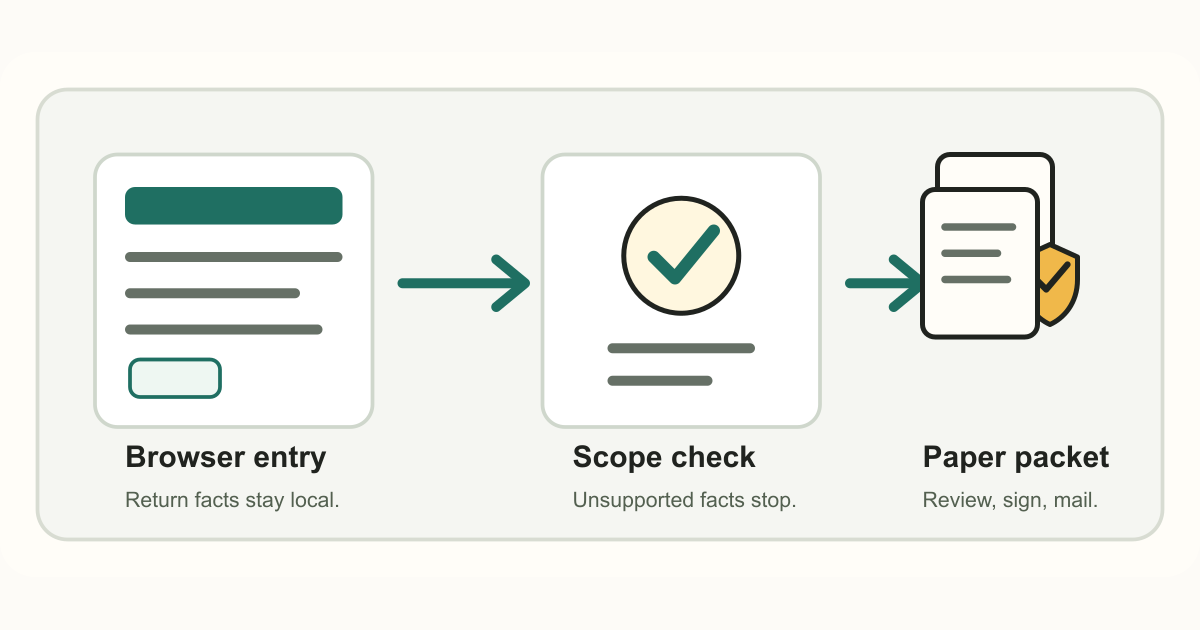
Compare whether the service prepares the election, collects every shareholder consent, handles late-election relief, submits by IRS-accepted delivery, stores proof records, and provides professional review. Tax Paperwork is a browser-local draft preview; it does not submit, fax, mail, track, or provide tax advice.
Comparison checklist
| Question | Why it matters | Tax Paperwork boundary |
|---|---|---|
| Does the provider submit the election? | Submission and proof records are the core filing-service promise. | Tax Paperwork does not submit, fax, mail, or track Form 2553. |
| Who collects shareholder consent? | Missing consent can break the election record. | Tax Paperwork can remind users about consent records; it does not prove consent. |
| Is late-election relief included? | Late relief can require facts, statements, and professional judgment. | Tax Paperwork does not decide eligibility or write relief narratives. |
| Who keeps proof? | Fax receipts, mail records, and IRS letters need a reliable system of record. | Proof records stay with the user, not Tax Paperwork. |
When a service or professional may fit better
- The election is late, the entity has unusual ownership, or the effective date affects prior tax returns.
- Payroll, state tax, investor, or reasonable-compensation questions depend on the election.
- The business wants someone else to submit, monitor, or interpret IRS correspondence.
Source and advice boundary
This page is education-only and not tax, legal, accounting, filing, payment, mailing, faxing, upload, confirmation, or representation advice. IRS.gov and current official instructions control Form 2553 mechanics.
What to check next
Use the IRS Form 2553 sources first, then decide whether a browser-local draft, a filing service, or a CPA, EA, or attorney is appropriate for the business facts.
Tax Paperwork can help organize public-preview draft context for some narrow workflows, but the user remains responsible for official-source review, professional advice when needed, and customer-controlled submission records.
Common risk
The common mistake is treating a draft, checklist, payment receipt, upload receipt, mailing receipt, or third-party summary as IRS confirmation. Keep records, but verify official channel rules and follow-up through IRS.gov, official correspondence, or qualified professional help.
Official source starting points
Last updated June 24, 2026.